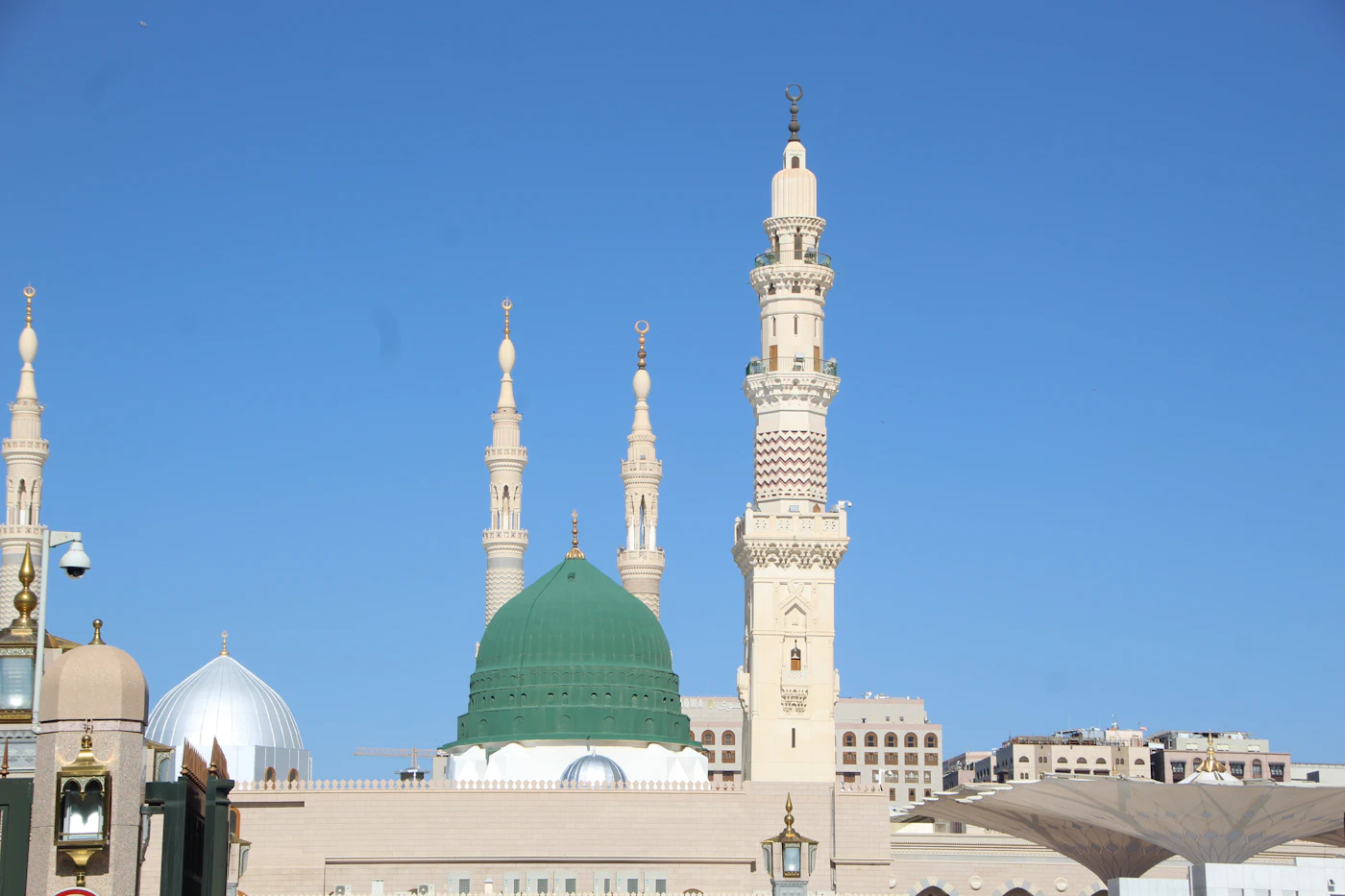
La vie du Prophète Muhammad ﷺ année après année, uniquement d'après le Coran et les hadiths authentiques. Quand les historiens divergent sur les dates, nous le signalons.
Al-Masjid an-Nabawi · Photo: Unsplash
Chronologie
c. 570—
Naissance à La Mecque
Le Prophète ﷺ est né à La Mecque l'année dite de l'Éléphant, vers 570 ; la date exacte est discutée par les historiens. Il a lui-même dit que le lundi était le jour de sa naissance et celui où la révélation lui fut donnée. Son père était mort avant sa naissance ; il grandit orphelin, sous la garde de son grand-père puis de son oncle. Le Coran lui rappelle : ne t'a-t-Il pas trouvé orphelin, puis Il t'a accueilli ?
Abu Qatada al-Ansari (Allah be pleased with him) reported that the Messenger of Allah (ﷺ) was asked about his fasting. The Messenger of Allah (ﷺ) felt annoyed. Thereupon 'Umar (Allah be pleased with him) said:We are pleased with Allah as the Lord, with Islam as our Code of Life, with Muhammad as the Messenger and with our pledge (to you for willing and cheerful submission) as a (sacred) commitment. He was then asked about perpetual fasting, whereupon he said: He neither fasted nor did he break it, or he did not fast and he did not break it. He was then asked about fasting for two days and breaking one day. He (the Holy Prophet) said: And who has strength enough to do it? He was asked about fasting for a day and breaking for two days, whereupon he said: May Allah bestow upon us strength to do it. He was then asked about fasting for a day and breaking on the other, whereupon he said: That is the fasting of my brother David (peace be upon him). He was then asked about fasting on Monday, whereupon he said: It was the day on which I was born. on which I was commissioned with prophethood or revelation was sent to me, (and he further) said: Three days' fasting every month and of the whole of Ramadan every year is a perpetual fast. He was asked about fasting on the day of 'Arafa (9th of Dhu'I-Hijja), whereupon he said: It expiates the sins of the preceding year and the coming year. He was asked about fasting on the day of 'Ashura (10th of Muharram), whereupon be said: It expiates the sins of the preceding year. (Imam Muslim said that in this hadith there is a) narration of Imam Shu'ba that he was asked about fasting on Monday and Thursday, but we (Imam Muslim) did not mention Thursday for we found it as an error (in reporting).
Avant la prophétie, il était connu à La Mecque pour son honnêteté et son bon caractère. Il épousa Khadija bint Khuwaylid, femme noble de Quraych ; les historiens situent généralement ce mariage vers 595 (âges et dates varient selon les récits). Elle le soutint de ses biens et de son cœur, et fut la première à croire en son message. Le Prophète ﷺ l'a comptée parmi les meilleures femmes du monde.
Preuves
وَوَجَدَكَ عَآئِلٗا فَأَغۡنَىٰ
8. Ne t’a-t-Il pas trouvé pauvre, et Il t’a alors enrichi ?
Narrated `Ali:I heard Allah's Messenger (ﷺ) saying (as below) Narrated `Ali: The Prophet (ﷺ) said, "The best of the world's women is Mary (at her lifetime), and the best of the world's women is Khadija (at her lifetime).
Vers l'âge de quarante ans, il adorait Allah seul dans la grotte de Hira. L'ange Jibril vint et dit : « Lis ! », et les premiers versets de la sourate al-Alaq furent révélés. Il revint tremblant auprès de Khadija, qui le réconforta : Allah ne t'humiliera jamais. Après une pause de la révélation, la sourate al-Muddaththir lui ordonna de se lever et d'avertir.
Narrated 'Aisha (the mother of the faithful believers):The commencement of the Divine Inspiration to Allah's Messenger (ﷺ) was in the form of good dreams which came true like bright daylight, and then the love of seclusion was bestowed upon him. He used to go in seclusion in the cave of Hira where he used to worship (Allah alone) continuously for many days before his desire to see his family. He used to take with him the journey food for the stay and then come back to (his wife) Khadija to take his food likewise again till suddenly the Truth descended upon him while he was in the cave of Hira. The angel came to him and asked him to read. The Prophet (ﷺ) replied, "I do not know how to read." The Prophet (ﷺ) added, "The angel caught me (forcefully) and pressed me so hard that I could not bear it any more. He then released me and again asked me to read and I replied, 'I do not know how to read.' Thereupon he caught me again and pressed me a second time till I could not bear it any more. He then released me and again asked me to read but again I replied, 'I do not know how to read (or what shall I read)?' Thereupon he caught me for the third time and pressed me, and then released me and said, 'Read in the name of your Lord, who has created (all that exists), created man from a clot. Read! And your Lord is the Most Generous." (96.1, 96.2, 96.3) Then Allah's Messenger (ﷺ) returned with the Inspiration and with his heart beating severely. Then he went to Khadija bint Khuwailid and said, "Cover me! Cover me!" They covered him till his fear was over and after that he told her everything that had happened and said, "I fear that something may happen to me." Khadija replied, "Never! By Allah, Allah will never disgrace you. You keep good relations with your kith and kin, help the poor and the destitute, serve your guests generously and assist the deserving calamity-afflicted ones." Khadija then accompanied him to her cousin Waraqa bin Naufal bin Asad bin 'Abdul 'Uzza, who, during the pre-Islamic Period became a Christian and used to write the writing with Hebrew letters. He would write from the Gospel in Hebrew as much as Allah wished him to write. He was an old man and had lost his eyesight. Khadija said to Waraqa, "Listen to the story of your nephew, O my cousin!" Waraqa asked, "O my nephew! What have you seen?" Allah's Messenger (ﷺ) described whatever he had seen. Waraqa said, "This is the same one who keeps the secrets (angel Gabriel) whom Allah had sent to Moses. I wish I were young and could live up to the time when your people would turn you out." Allah's Messenger (ﷺ) asked, "Will they drive me out?" Waraqa replied in the affirmative and said, "Anyone (man) who came with something similar to what you have brought was treated with hostility; and if I should remain alive till the day when you will be turned out then I would support you strongly." But after a few days Waraqa died and the Divine Inspiration was also paused for a while.
Les premières années, l'appel fut surtout discret. Quand Allah révéla « Et avertis les gens de ta famille la plus proche », le Prophète ﷺ monta sur Safa et appela les clans de Quraych. Ils reconnurent ne l'avoir jamais trouvé menteur, mais Abou Lahab le rejeta, et la sourate al-Masad fut révélée. Dès lors, l'hostilité envers les croyants grandit.
Narrated Ibn `Abbas:When the Verse:--'And warn your tribe of near-kindred, was revealed, the Prophet (ﷺ) ascended the Safa (mountain) and started calling, "O Bani Fihr! O Bani `Adi!" addressing various tribes of Quraish till they were assembled. Those who could not come themselves, sent their messengers to see what was there. Abu Lahab and other people from Quraish came and the Prophet (ﷺ) then said, "Suppose I told you that there is an (enemy) cavalry in the valley intending to attack you, would you believe me?" They said, "Yes, for we have not found you telling anything other than the truth." He then said, "I am a warner to you in face of a terrific punishment." Abu Lahab said (to the Prophet) "May your hands perish all this day. Is it for this purpose you have gathered us?" Then it was revealed: "Perish the hands of Abu Lahab (one of the Prophet's uncles), and perish he! His wealth and his children will not profit him...." (111.1-5)
Face à la persécution, un groupe de musulmans émigra en Abyssinie, où un roi chrétien juste les protégea. Les historiens mentionnent deux émigrations ; les nombres et les années varient selon les récits. Le Coran réconforta les croyants : la terre d'Allah est vaste, et les endurants recevront leur récompense sans compter.
10. Dis encore : « Ô vous Mes serviteurs qui avez cru, craignez votre Seigneur ! » À ceux qui auront bien agi dans ce bas monde est réservée une belle récompense. La terre d’Allah est si vaste, et ceux qui savent être patients auront leur pleine rétribution sans que rien ne leur en soit compté.
41. Ceux qui ont émigré pour la cause d’Allah, après avoir été lésés, Nous les établirons en ce bas monde et leur donnerons demeure honorable. Mais la rétribution dans l’autre monde est bien meilleure, si seulement ils savaient !
Peu avant l'Hégire, le Prophète ﷺ perdit Khadija et son oncle Abou Talib, ce qui alourdit l'épreuve. Il alla appeler les gens de Taïf, qui le repoussèrent durement. Il confia plus tard à Aïcha que ce fut l'un des jours les plus durs. Quand l'ange des montagnes lui proposa de les anéantir, il dit : j'espère qu'Allah fera sortir de leur descendance des gens qui L'adoreront seul.
29. Et lorsque nous amenâmes vers toi un petit groupe de djinns pour qu’ils écoutent le Coran, ils dirent, présents (à sa lecture) : « Écoutez bien. » Et quand cela fut achevé, ils s’en retournèrent vers les leurs afin de les avertir.
Narrated `Aisha:That she asked the Prophet (ﷺ) , 'Have you encountered a day harder than the day of the battle) of Uhud?" The Prophet (ﷺ) replied, "Your tribes have troubled me a lot, and the worse trouble was the trouble on the day of 'Aqaba when I presented myself to Ibn `Abd-Yalail bin `Abd-Kulal and he did not respond to my demand. So I departed, overwhelmed with excessive sorrow, and proceeded on, and could not relax till I found myself at Qarnath-Tha-alib where I lifted my head towards the sky to see a cloud shading me unexpectedly. I looked up and saw Gabriel in it. He called me saying, 'Allah has heard your people's saying to you, and what they have replied back to you, Allah has sent the Angel of the Mountains to you so that you may order him to do whatever you wish to these people.' The Angel of the Mountains called and greeted me, and then said, "O Muhammad! Order what you wish. If you like, I will let Al-Akh-Shabain (i.e. two mountains) fall on them." The Prophet (ﷺ) said, "No but I hope that Allah will let them beget children who will worship Allah Alone, and will worship None besides Him."
Allah transporta Son serviteur de nuit de la Mosquée sacrée à la Mosquée al-Aqsa, puis à travers les cieux, comme l'indiquent les sourates al-Isra et an-Najm. Les cinq prières quotidiennes furent prescrites lors de ce voyage, selon les hadiths authentiques. Sa date exacte est discutée ; il eut lieu à La Mecque avant l'Hégire. Nous ne fixons pas de date non prouvée.
1. Gloire soit rendue à Celui Qui fit voyager Son serviteur de nuit, depuis la Mosquée Sacrée (Al Masjid Al-Harâm) à la Mosquée Éloignée (Al Masjid Al-Aqçâ), dont Nous avons béni les environs, pour lui montrer certains de Nos Signes. C’est Lui Qui Entend Tout et Voit parfaitement clair.
Lors des saisons du pèlerinage, des gens de Yathrib (Médine) rencontrèrent le Prophète ﷺ à Aqaba, embrassèrent l'islam et lui promirent leur soutien. Oubada ibn as-Samit rapporte le serment : ne rien associer à Allah, ne pas voler, ne pas commettre la fornication, ne pas tuer leurs enfants, ne pas calomnier, et ne pas désobéir dans le bien. Cela ouvrit la voie à l'Hégire.
12. Ô Prophète ! Quand les croyantes, par un serment d’allégeance, viennent jurer devant toi qu’elles n’associeront rien à Allah, qu’elles ne voleront point, ne commettront point la fornication, ne tueront point leurs enfants, n’attribueront pas mensongèrement (à leurs maris des enfants adultérins), ni ne te désobéiront en ce qui est convenable, alors accepte leur allégeance, et implore pour elles le pardon d’Allah, car Allah est Absoluteur et Tout Miséricordieux.
Narrated 'Ubada bin As-Samit: who took part in the battle of Badr and was a Naqib (a person heading a group of six persons), on the night of Al-'Aqaba pledge: Allah's Apostle said while a group of his companions were around him, "Swear allegiance to me for: 1. Not to join anything in worship along with Allah. 2. Not to steal. 3. Not to commit illegal sexual intercourse. 4. Not to kill your children. 5. Not to accuse an innocent person (to spread such an accusation among people). 6. Not to be disobedient (when ordered) to do good deed." The Prophet (ﷺ) added: "Whoever among you fulfills his pledge will be rewarded by Allah. And whoever indulges in any one of them (except the ascription of partners to Allah) and gets the punishment in this world, that punishment will be an expiation for that sin. And if one indulges in any of them, and Allah conceals his sin, it is up to Him to forgive or punish him (in the Hereafter)." 'Ubada bin As-Samit added: "So we swore allegiance for these." (points to Allah's Apostle)
Quand Quraych complota de le tuer, Allah autorisa le Prophète ﷺ à émigrer. Il quitta La Mecque avec Abou Bakr ; ils se cachèrent dans une grotte pendant que l'ennemi les cherchait, et le Coran rapporte ses paroles : ne t'afflige pas, Allah est avec nous. Il arriva à Médine où les Ansar l'accueillirent. Le calendrier islamique fut plus tard compté à partir de l'année de l'Hégire.
40. Et si vous ne venez pas à son secours (au secours du Prophète), Allah est déjà venu à son secours lorsque les mécréants l’avaient expulsé et qu’il était le deuxième des deux (hommes que les mécréants avaient expulsés).[5] Ils étaient alors dans la grotte et, lui, disait à son compagnon : « Ne t’afflige point, car Allah est avec nous ! » Allah fit alors descendre sur lui Sa quiétude (sakîna), l’appuya d’armées que vous ne pouviez voir, jeta bas la parole des mécréants et éleva la Parole d’Allah, car Allah est Tout-Puissant et Sage.
Notes du traducteur
[5] Car ils étaient deux : le Prophète (paix et bénédiction d’Allah sur lui) et Abu Bakr.
30. (Rappelle-toi, ô Muhammad) lorsque les mécréants conspiraient contre toi pour te capturer, t’assassiner ou t’exiler. Ils conspirèrent, mais Allah a déjoué leur conspiration. Car Allah surpasse tous les conspirateurs.
Les premières mosquées : Qouba et la Mosquée du Prophète
Arrivés à Médine, le Prophète ﷺ et ses compagnons bâtirent des mosquées, d'abord à Qouba puis la Mosquée du Prophète au cœur de la ville. Le Coran loue une mosquée fondée sur la piété dès le premier jour. La mosquée devint le centre du culte, du savoir et de la vie communautaire.
108. Ne t’y rends jamais ! (pour prier). Une mosquée fondée dès le premier jour sur la piété sied mieux à ta présence. Là, se trouvent des hommes qui aiment à se purifier, et Allah aime ceux qui se purifient.
À Médine, les musulmans prièrent vers Bayt al-Maqdis (Jérusalem) pendant seize ou dix-sept mois. Le Prophète ﷺ désirait se tourner vers la Kaaba, et Allah révéla : tourne ton visage vers la Mosquée sacrée. La première prière vers la Kaaba fut celle de l'Asr, et un compagnon informa les fidèles d'une autre mosquée, qui se tournèrent en pleine prière.
144. Nous te voyons tourner la face vers le ciel le scrutant de tous côtés. Nous t’orientons alors vers une direction (Qibla) qui te satisfait. Tourne donc ton visage vers la Mosquée Sacrée. Où que vous soyez, vous tournerez (tous)[41] vers elle vos visages. Ceux à qui fut donné le Livre savent certainement que c’est la vérité venue de leur Seigneur. Et Allah n’est point distrait de ce qu’ils font.
Notes du traducteur
[41] Le passage de « tu » à « vous » montre qu’Allah s’adresse d’abord au Prophète, puis aux croyants.
143. Nous avons aussi fait de vous une communauté du juste milieu pour que vous soyez témoins vis-à-vis des hommes et que le Messager soit témoin vis-à-vis de vous. Nous n’avons établi la direction rituelle vers laquelle tu t’orientais[40] que pour savoir qui suivrait le Messager et qui lui tournerait les talons. Or quelque lourd que fût (ce transfert), il ne le sera point pour ceux qu’Allah a guidés. Et Allah n’aurait pas laissé perdre le prix de votre foi, car Allah est pour les hommes Tout Compatissant et Tout Miséricordieux.
Narrated Al-Bara' (bin 'Azib): When the Prophet (ﷺ) came to Medina, he stayed first with his grandfathers or maternal uncles from Ansar. He offered his prayers facing Baitul-Maqdis (Jerusalem) for sixteen or seventeen months, but he wished that he could pray facing the Ka'ba (at Mecca). The first prayer which he offered facing the Ka'ba was the 'Asr prayer in the company of some people. Then one of those who had offered that prayer with him came out and passed by some people in a mosque who were bowing during their prayers (facing Jerusalem). He said addressing them, "By Allah, I testify that I have prayed with Allah's Messenger (ﷺ) facing Mecca (Ka'ba).' Hearing that, those people changed their direction towards the Ka'ba immediately. Jews and the people of the scriptures used to be pleased to see the Prophet (ﷺ) facing Jerusalem in prayers but when he changed his direction towards the Ka'ba, during the prayers, they disapproved of it. Al-Bara' added, "Before we changed our direction towards the Ka'ba (Mecca) in prayers, some Muslims had died or had been killed and we did not know what to say about them (regarding their prayers.) Allah then revealed: And Allah would never make your faith (prayers) to be lost (i.e. the prayers of those Muslims were valid).' " (2:143).
La deuxième année après l'Hégire, Allah prescrivit le jeûne de Ramadan, comme il fut prescrit à ceux d'avant nous, afin que nous atteignions la piété. Ramadan est le mois où le Coran fut descendu comme guidance pour les gens. C'est l'année couramment rapportée ; l'obligation elle-même est énoncée dans le Coran.
183. Ô vous qui avez cru ! Le jeûne (Aç-Ciyâm) vous a été prescrit comme il a été prescrit à ceux qui vous ont précédés : ainsi finirez-vous par craindre pieusement.
185. C’est en ce mois de Ramadan que fut révélé le Coran en guide (hudâ) pour les hommes (vers la juste voie), et comme preuves évidentes de la bonne orientation et du discernement. Quiconque, alors, est présent en ce mois[55] qu’il (le) jeûne ! Et si quelqu’un est malade ou parti en voyage, il (s’acquittera) d’un nombre équivalent d’autres jours. Allah veut pour vous l’aisance et ne veut pas pour vous la difficulté ; afin que vous complétiez les jours dus et que vous rendiez gloire à Allah Qui vous a bien guidés. Peut-être alors (Lui) serez-vous reconnaissants !
Notes du traducteur
[55] Encore présent, encore vivant, épargné par la mort. Autrement dit : n’est pas en voyage.
À Badr, une petite troupe musulmane mal équipée affronta une armée bien plus nombreuse de Quraych. Les croyants implorèrent leur Seigneur, qui répondit qu'Il les soutiendrait par des anges. Allah leur donna la victoire alors qu'ils étaient peu nombreux et faibles, et le Coran l'appelle le Jour du Discernement.
123. Allah vous avait bien fait triompher à Badr[16]quand vous étiez bien inférieurs. Alors, craignez Allah, peut-être serez-vous reconnaissants.
Notes du traducteur
[16] L’emploi du plus-que-parfait se justifie ici par l’antériorité de la bataille de Badr par rapport à celle de ’Uhud à laquelle il est fait allusion dans le verset précédent.
9. (Souvenez-vous aussi) lorsque vous imploriez le secours de votre Seigneur et qu’Il vous répondit : « Je vous envoie en renfort mille Anges se succédant en vagues. »
41. Et sachez que, quelque butin que vous récoltiez, il en revient le cinquième à Allah, au Messager, à ses proches, aux orphelins, aux pauvres et aux voyageurs de grand chemin, si vous croyez en Allah et à ce que Nous avons révélé à Notre serviteur[4] le jour du Discernement (Al-Furqân),[5] jour où les deux troupes (ennemies) se rencontrèrent. Allah est de Toute chose Infiniment Capable.
Notes du traducteur
[4] Muhammad, (paix et bénédiction d’Allah sur lui).
[5] Jour de Badr, jour de vérité où il fut possible de discerner entre le bien et le mal. Mais le mot « Al-Furqân » est aussi l’un des noms du Coran.
Quraych revint avec une grande armée et la bataille eut lieu près du mont Ouhoud. Les musulmans avaient d'abord l'avantage, mais des archers quittèrent leur poste, la situation se retourna et de nombreux compagnons tombèrent en martyrs. Le Coran tire de ce jour des leçons d'obéissance, de patience et de confiance en Allah. Le Prophète ﷺ fut blessé mais resta ferme.
121. (Souviens-toi, ô Muhammad) lorsque tu quittas, au petit jour, ta famille pour attribuer aux croyants leurs postes de combat. Allah Entend Tout et Il est Omniscient.
152. Allah a tenu Sa promesse envers vous lorsque, par Sa permission, vous les tailliez par vos épées,[20] jusqu’au moment où vous avez faibli, vous avez disputé les ordres, puis vous les avez carrément enfreints, alors qu’Il vous avait laissés entrevoir ce que vous aimiez.[21] Parmi vous, il en était qui voulaient ce bas monde, et il en était qui voulaient l’autre monde. Puis, pour vous mettre à l’épreuve, Il vous a fait fuir devant eux. Mais Il vous a déjà pardonné, car Allah est Plein de Faveurs pour les croyants.
Notes du traducteur
[20] Vous les frappiez d’estoc et de taille avec vos épées.
[21] Gagner la bataille.
De nombreuses tribus se coalisèrent contre Médine, et les musulmans creusèrent un fossé pour défendre la ville. Le siège fut très dur : le Coran décrit les regards troublés et les cœurs remontés jusqu'à la gorge. Allah envoya un vent et des armées invisibles contre les coalisés, qui se retirèrent sans atteindre leur but.
9. Ô vous qui avez cru ! Rappelez-vous ce bienfait d’Allah envers vous, lorsque des armées vous ont assiégés et que Nous avons envoyé contre elles un vent et des troupes que vous ne pouviez voir.[3] Allah Voit clairement tout ce que vous faites.
10. Ils venaient alors vers vous par en dessus de vous et par en dessous. Les yeux étaient révulsés et les gorges nouées, et vous hasardiez au sujet d’Allah les fausses conjectures.
22. Lorsque les croyants virent les coalisés, ils dirent : « Voilà la promesse que nous avaient faite Allah et Son Messager. Allah et Son Messager disaient donc vrai. » Et cela ne fit qu’accroître leur foi et leur soumission.
Le Prophète ﷺ partit avec ses compagnons pour la Omra, mais Quraych les arrêta à al-Houdaybiya. Les compagnons prêtèrent serment sous l'arbre, et Allah dit qu'Il était satisfait d'eux. Un traité de paix, difficile aux yeux de certains, fut conclu ; Allah l'appela une victoire éclatante, et beaucoup entrèrent en islam dans la paix qui suivit.
Preuves
إِنَّا فَتَحۡنَا لَكَ فَتۡحٗا مُّبِينٗا
1. Nous t’avons accordé une victoire évidente,[1]
Notes du traducteur
[1] Il s’agit ici de la trêve conclue à Al-Ḥudaybiyyah avec les mécréants. Cette trêve était une véritable victoire, qui préludait à la conquête de La Mecque.
18. Allah a été satisfait des croyants qui te faisaient allégeance sous l’arbre. Il a su ce qu’il y avait au fond de leurs cœurs, a fait donc descendre sur eux la quiétude, et les a récompensés par une victoire imminente,[2]
Notes du traducteur
[2] Il s’agit de la conquête, toute proche, de Khaybar, consécutive à la trêve de Al-Hudaybiyyah et précédant la conquête de La Mecque.
27. Allah confirme par la vérité la vision de Son Messager : « Vous entrerez, en toute sécurité, dans la Mosquée Sacrée par la volonté d’Allah, la tête rasée ou les cheveux coupés, et vous n’y aurez nulle crainte. ». Il Savait ce que vous ne saviez pas et (Allah) vous a donné, d’abord,[6] une victoire immédiate.[7]
Notes du traducteur
[6] Avant la conquête de La Mecque.
[7] La facile victoire de Khaybar en prélude à la conquête de La Mecque.
Après al-Houdaybiya, les musulmans marchèrent sur Khaybar, ville fortifiée au nord de Médine. Allah leur y donna la victoire, et le Coran évoque les nombreux butins promis aux croyants. Ali ibn Abi Talib porta l'étendard le jour décisif, comme le rapportent les hadiths authentiques.
20. Allah vous a promis de riches butins dont vous prendrez possession bientôt, et Il vous a accordé rapidement ce butin-ci ;[3] Il a éloigné de vous les mains (ennemies) des hommes, afin que cela soit un Signe aux croyants et pour que vous soyez guidés vers une voie droite.
Notes du traducteur
[3] Le butin de Khaybar, qui sera obtenu sans combat.
Quraych ayant rompu le traité, le Prophète ﷺ marcha sur La Mecque avec une grande armée et y entra presque sans combat. Il débarrassa la Kaaba de ses 360 idoles en récitant : la vérité est venue et le faux a disparu. Il pardonna à ses anciens ennemis, et les gens entrèrent en foule dans la religion d'Allah, comme le décrit la sourate an-Nasr.
Preuves
إِذَا جَآءَ نَصۡرُ ٱللَّهِ وَٱلۡفَتۡحُ
1. Lorsque viendra le secours d’Allah (annonçant) la victoire,
Narrated `Abdullah:When the Prophet (ﷺ) entered Mecca on the day of the Conquest, there were 360 idols around the Ka`ba. The Prophet (ﷺ) started striking them with a stick he had in his hand and was saying, "Truth has come and Falsehood will neither start nor will it reappear.
Peu après la conquête de La Mecque, les musulmans affrontèrent les tribus de Hawazin à Hounayn. Certains se réjouissaient de leur grand nombre, mais ils furent d'abord repoussés. Allah fit descendre Sa sérénité sur Son Messager et les croyants, ainsi que des armées invisibles, et la bataille se termina par la victoire — la victoire vient d'Allah, non du nombre.
25. Allah vous a secourus en divers endroits. Le jour de Hunayn (notamment), vous exultiez en raison de votre nombre, lequel ne vous a servi à rien. La terre était trop étroite pour vous, en dépit de sa vastitude. Puis vous avez pris la fuite et tourné le dos.
26. Allah fit, par la suite, descendre Sa quiétude (sakîna) sur Son Messager et sur les croyants. Il fit descendre des armées que vous ne pouviez voir et soumit au supplice ceux qui ont mécru. Voilà la rétribution des mécréants.
Par une chaleur et une gêne extrêmes, le Prophète ﷺ conduisit une grande armée vers le nord, à Tabouk. Les compagnons donnèrent généreusement pour l'équiper. Il n'y eut pas de combat, mais l'expédition éprouva la sincérité, et le Coran relate qu'Allah accepta le repentir des trois restés en arrière qui se repentirent sincèrement.
117. Allah a accepté le repentir du Prophète, des Émigrés et des Alliés qui l’avaient suivi aux heures pénibles, alors que les cœurs de certains d’entre eux allaient être dévoyés. Puis Il a accepté leur repentir car, à leur égard, Il est Tout Compatissant et Tout Miséricordieux.
118. (Et Il a accepté aussi le repentir) des trois (hommes) qui étaient restés à l’arrière (n’étaient pas partis au combat) et devant qui la terre, si vaste qu’elle fût, devenait (beaucoup trop) étroite. Leurs propres personnes leur semblaient si exiguës qu’ils se rendirent à l’évidence qu’il n’est point d’autre refuge où se sauver d’Allah qu’auprès de Lui. Puis Il accepta leur repentir pour qu’ils reviennent (à Lui). Car Allah est, Lui, le Tout Absoluteur, le Tout Miséricordieux.
Le Prophète ﷺ accomplit le Hajj avec une foule immense de musulmans. Dans son sermon, il déclara que leur sang, leurs biens et leur honneur étaient sacrés les uns pour les autres, et demanda : ai-je transmis ? Le verset fut révélé : aujourd'hui J'ai parachevé pour vous votre religion et complété Mon bienfait.
3. Il vous est défendu (de consommer la chair de) la bête morte, le sang, la viande de porc, et tout ce qui a été (égorgé) sous l’invocation d’un autre nom que celui d’Allah ; la bête étranglée ou étouffée, frappée à mort, morte d’une chute ou d’un coup de corne ; la bête dévorée par un fauve, à moins que celle-ci n’ait déjà été égorgée. (Il vous est également défendu de consommer) la chair de la bête immolée sur les autels (des idolâtres), et de consulter le sort au moyen de flèches (divinatoires). Voilà qui est vraiment pervers. Aujourd’hui, ceux qui ont mécru désespèrent de (vous voir abjurer) votre religion. Ne les craignez donc pas, et craignez-Moi. Aujourd’hui, J’ai mené votre religion à son point d’accomplissement, Je vous ai comblés de Ma grâce tout entière, et J’ai agréé pour vous l’Islam comme religion. Quiconque, cependant, se trouve contraint, en temps de famine et sans l’intention de pécher, de consommer de ces aliments défendus, (doit savoir qu’) Allah est Absoluteur et Tout Miséricordieux.
Narrated `Ikrima:Ibn `Abbas said: "Allah's Messenger (ﷺ) delivered a sermon on the Day of Nahr, and said, 'O people! (Tell me) what is the day today?' The people replied, 'It is the forbidden (sacred) day.' He asked again, 'What town is this?' They replied, 'It is the forbidden (Sacred) town.' He asked, 'Which month is this?' They replied, 'It is the forbidden (Sacred) month.' He said, 'No doubt! Your blood, your properties, and your honor are sacred to one another like the sanctity of this day of yours, in this (sacred) town (Mecca) of yours, in this month of yours.' The Prophet (ﷺ) repeated his statement again and again. After that he raised his head and said, 'O Allah! Haven't conveyed (Your Message) to them'. Haven't I conveyed Your Message to them?' " Ibn `Abbas added, "By Him in Whose Hand my soul is, the following was his will (Prophet's will) to his followers:--It is incumbent upon those who are present to convey this information to those who are absent Beware don't renegade (as) disbelievers (turn into infidels) after me, Striking the necks (cutting the throats) of one another.' "
En Rabi al-Awwal de l'an 11 de l'Hégire, le Prophète ﷺ tomba malade chez Aïcha et y mourut ; le mois fait l'unanimité, le jour varie selon les récits. Ses dernières paroles furent : Ô Allah, le Compagnon suprême. Abou Bakr rappela aux compagnons affligés le verset : Muhammad n'est qu'un messager ; des messagers sont passés avant lui. Le message qu'il a laissé — le Coran et la Sunna — demeure.
144. Muhammad n’est qu’un Messager que d’autres Messagers ont précédé. S’il venait à mourir, ou s’il était tué, tourneriez-vous donc les talons ? Celui qui tourne les talons ne nuira en rien à Allah, et Allah récompensera les reconnaissants.
40. Muhammad n’est le père d’aucun homme parmi vous,[8] mais (il est) le Messager d’Allah et le Sceau des Prophètes. Allah est de Toute chose Omniscient.
Notes du traducteur
[8] Tous les enfants mâles du Prophète sont morts de son vivant. Seules ses filles survécurent assez longtemps pour assister à l’avènement de l’Islam.
Narrated `Aisha:When the Prophet (ﷺ) was healthy, he used to say, "No soul of a prophet is captured till he is shown his place in Paradise and then he is given the option." When death approached him while his head was on my thigh, he became unconscious and then recovered his consciousness. He then looked at the ceiling of the house and said, "O Allah! (with) the highest companions." I said (to myself), "Hence, he is not going to choose us." Then I realized that what he had said was the application of the narration which he used to mention to us when he was healthy. The last word he spoke was, "O Allah! (with) the highest companion."
Dix compagnons célèbres, avec ce qu'en disent le Coran et les hadiths authentiques.
أبو بكر الصديق رضي الله عنه
Abou Bakr as-Siddiq
Abou Bakr fut l'ami le plus proche du Prophète ﷺ et parmi les premiers hommes à embrasser l'islam. Il fut son compagnon dans la grotte lors de l'Hégire, mentionné dans le Coran comme « le second de deux ». Le Prophète ﷺ dit que s'il devait prendre un ami intime autre que son Seigneur, ce serait Abou Bakr, et le nomma l'homme qu'il aimait le plus. Après le Prophète ﷺ, il devint le premier calife.
40. Et si vous ne venez pas à son secours (au secours du Prophète), Allah est déjà venu à son secours lorsque les mécréants l’avaient expulsé et qu’il était le deuxième des deux (hommes que les mécréants avaient expulsés).[5] Ils étaient alors dans la grotte et, lui, disait à son compagnon : « Ne t’afflige point, car Allah est avec nous ! » Allah fit alors descendre sur lui Sa quiétude (sakîna), l’appuya d’armées que vous ne pouviez voir, jeta bas la parole des mécréants et éleva la Parole d’Allah, car Allah est Tout-Puissant et Sage.
Notes du traducteur
[5] Car ils étaient deux : le Prophète (paix et bénédiction d’Allah sur lui) et Abu Bakr.
Narrated Abu Sa`id Al-Khudri:Allah's Messenger (ﷺ) addressed the people saying, "Allah has given option to a slave to choose this world or what is with Him. The slave has chosen what is with Allah." Abu Bakr wept, and we were astonished at his weeping caused by what the Prophet (ﷺ) mentioned as to a Slave ( of Allah) who had been offered a choice, (we learned later on) that Allah's Messenger (ﷺ) himself was the person who was given the choice, and that Abu Bakr knew best of all of us. Allah's Messenger (ﷺ) added, "The person who has favored me most of all both with his company and wealth, is Abu Bakr. If I were to take a Khalil other than my Lord, I would have taken Abu Bakr as such, but (what relates us) is the Islamic brotherhood and friendliness. All the gates of the Mosque should be closed except the gate of Abu Bakr."
Narrated `Amr bin Al-As:The Prophet (ﷺ) deputed me to read the Army of Dhat-as-Salasil. I came to him and said, "Who is the most beloved person to you?" He said, " `Aisha." I asked, "Among the men?" He said, "Her father." I said, "Who then?" He said, "Then `Umar bin Al-Khattab." He then named other men.
Omar était connu pour sa force et sa fermeté dans la vérité. Le Prophète ﷺ dit que Satan ne le rencontrait jamais sur un chemin sans en prendre un autre, et que s'il y avait des inspirés dans cette communauté, Omar en serait. Il fut cité parmi les hommes les plus aimés du Prophète ﷺ après Abou Bakr. Il devint le deuxième calife, connu pour sa justice.
Sa'd b. Waqqas reported that Umar sought permission from Allah's Messenger (ﷺ) to visit him when some women of the Quraish were busy in talking with him and raising their voices above his Voiee. When'Umar sought permission they stood up and went hurriedly behind the curtain. Allah's Messenger (ﷺ) gave him permission smilingly. Thereupon 'Umar said:Allah's Messenger, may Allah keep you happy all your life. Then Allah's Messenger (ﷺ) said: I wonder at these women who were with me and no sooner did they hear your voice, they immediately went behind the curtain. Thereupon 'Umar said: Allah's Messenger, you have more right that they should fear you. Then Umar (addressing the women) said: O ye enemies of yourselves, do you fear me and fear not the Messenger of Allah (ﷺ)? They said: Yes, you are harsh and strict as compared to the Messenger of Allah (ﷺ). Thereupon, Allah's Messenger (maypeace be upon him) said: By Him in Whose Hand is my life, if satan would encounter you in the way he would certainly take a different way from that of yours.
A'isha reported Allah's Messenger (ﷺ) as saying:There had been among the people before you inspired persons and if there were any such among my Umma Umar b. Khattab would be one of them. Ibn Wahb explained the word Muhaddathun as those who receive hint from the High (Mulhamun).
Narrated `Amr bin Al-As:The Prophet (ﷺ) deputed me to read the Army of Dhat-as-Salasil. I came to him and said, "Who is the most beloved person to you?" He said, " `Aisha." I asked, "Among the men?" He said, "Her father." I said, "Who then?" He said, "Then `Umar bin Al-Khattab." He then named other men.
Othman était connu pour sa pudeur et sa générosité. Le Prophète ﷺ dit : ne serais-je pas pudique envers un homme devant qui même les anges sont pudiques ? Il dépensa beaucoup de ses biens pour les musulmans. Il devint le troisième calife, et sous son califat le Coran fut réuni en un exemplaire de référence envoyé dans les provinces.
`Aisha reported:Allah's Messenger (ﷺ) was lying in the bed in my apartment with his thigh uncovered and Abu Bakr sought permission to enter. It was given to him and he conversed in the same very state (the Prophet's thigh or shank uncovered). Then `Umar sought permission for entering and it was given to him and he conversed in that very state. Then `Uthman sought permission to enter; Allah's Messenger (ﷺ) sat down and he set right his clothes. Muhammad (one of the narrators) said: I do not say that it happened on the same day. He (`Uthman) then entered and conversed and as he went out, `Aisha said: Abu Bakr entered and you did not stir and did not observe much care (in arranging your clothes), then `Umar entered and you did not stir and did not arrange your clothes, then `Uthman entered and you got up and set your clothes right, so he (ﷺ) said: Should I not show modesty to one whom even the Angels show modesty.
Ali était le cousin du Prophète ﷺ, élevé dans sa maison, et parmi les premiers à embrasser l'islam, encore enfant. Il épousa Fatima, la fille du Prophète ﷺ. Le Prophète ﷺ lui dit : tu es pour moi ce qu'Aaron était pour Moïse, sauf qu'il n'y a pas de prophète après moi. Connu pour son savoir et son courage, il devint le quatrième calife.
Amir b Sa'd b. Abi Waqqas reported (on the authority of his father that Allah's Messenger (ﷺ) addressing 'Ali said:You are in the same position with relation to me as Aaron (Harun) was in relation to Moses but with (this explicit difference) that there is no prophet after me. Sa'd said: I had an earnest desire to hear it directly from Sa'd, so I met him and narrated to him what (his son) Amir had narrated to me, whereupon he said: Yes, I did hear it. I said: Did you hear it yourself? Thereupon he placed his fingers upon his ears and said: Yes, and if not, let both my ears become deaf.
Khadija fut la première épouse du Prophète ﷺ et la première à croire en lui. Lors de la première révélation, elle le réconforta et l'emmena chez Waraqa ibn Nawfal. Jibril lui apporta les salutations de son Seigneur et la bonne nouvelle d'une maison au Paradis. Le Prophète ﷺ dit que la meilleure femme de son temps était Khadija.
Narrated Abu Huraira: Gabriel came to the Prophet (ﷺ) and said, "O Allah's Messenger (ﷺ)! This is Khadija coming to you with a dish having meat soup (or some food or drink). When she reaches you, greet her on behalf of her Lord (i.e. Allah) and on my behalf, and give her the glad tidings of having a Qasab palace in Paradise wherein there will be neither any noise nor any fatigue (trouble) . "
Narrated `Ali:I heard Allah's Messenger (ﷺ) saying (as below) Narrated `Ali: The Prophet (ﷺ) said, "The best of the world's women is Mary (at her lifetime), and the best of the world's women is Khadija (at her lifetime).
Narrated 'Aisha (the mother of the faithful believers):The commencement of the Divine Inspiration to Allah's Messenger (ﷺ) was in the form of good dreams which came true like bright daylight, and then the love of seclusion was bestowed upon him. He used to go in seclusion in the cave of Hira where he used to worship (Allah alone) continuously for many days before his desire to see his family. He used to take with him the journey food for the stay and then come back to (his wife) Khadija to take his food likewise again till suddenly the Truth descended upon him while he was in the cave of Hira. The angel came to him and asked him to read. The Prophet (ﷺ) replied, "I do not know how to read." The Prophet (ﷺ) added, "The angel caught me (forcefully) and pressed me so hard that I could not bear it any more. He then released me and again asked me to read and I replied, 'I do not know how to read.' Thereupon he caught me again and pressed me a second time till I could not bear it any more. He then released me and again asked me to read but again I replied, 'I do not know how to read (or what shall I read)?' Thereupon he caught me for the third time and pressed me, and then released me and said, 'Read in the name of your Lord, who has created (all that exists), created man from a clot. Read! And your Lord is the Most Generous." (96.1, 96.2, 96.3) Then Allah's Messenger (ﷺ) returned with the Inspiration and with his heart beating severely. Then he went to Khadija bint Khuwailid and said, "Cover me! Cover me!" They covered him till his fear was over and after that he told her everything that had happened and said, "I fear that something may happen to me." Khadija replied, "Never! By Allah, Allah will never disgrace you. You keep good relations with your kith and kin, help the poor and the destitute, serve your guests generously and assist the deserving calamity-afflicted ones." Khadija then accompanied him to her cousin Waraqa bin Naufal bin Asad bin 'Abdul 'Uzza, who, during the pre-Islamic Period became a Christian and used to write the writing with Hebrew letters. He would write from the Gospel in Hebrew as much as Allah wished him to write. He was an old man and had lost his eyesight. Khadija said to Waraqa, "Listen to the story of your nephew, O my cousin!" Waraqa asked, "O my nephew! What have you seen?" Allah's Messenger (ﷺ) described whatever he had seen. Waraqa said, "This is the same one who keeps the secrets (angel Gabriel) whom Allah had sent to Moses. I wish I were young and could live up to the time when your people would turn you out." Allah's Messenger (ﷺ) asked, "Will they drive me out?" Waraqa replied in the affirmative and said, "Anyone (man) who came with something similar to what you have brought was treated with hostility; and if I should remain alive till the day when you will be turned out then I would support you strongly." But after a few days Waraqa died and the Divine Inspiration was also paused for a while.
Aïcha, fille d'Abou Bakr, fut une épouse du Prophète ﷺ et l'une des plus grandes savantes parmi les compagnons ; beaucoup de hadiths sont rapportés par elle. Le Prophète ﷺ la nomma la personne qu'il aimait le plus et lui dit que Jibril la saluait. Il dit que son mérite sur les autres femmes est comme celui du tharid sur les autres mets. Allah proclama son innocence dans le Coran (sourate an-Nour).
11. Ceux qui répandent des calomnies sont un groupe parmi vous. Ne croyez pas que ce soit un mal pour vous, mais plutôt un bien. Chacun d’entre eux devra répondre de son péché. Mais l’auteur de la plus grande part (de ces calomnies), aura un terrible supplice.
Narrated Abu Musa Al-Ash`ari:Allah's Messenger (ﷺ) said, "Many amongst men attained perfection but amongst women none attained the perfection except Mary, the daughter of `Imran and Asiya, the wife of Pharaoh. And the superiority of `Aisha to other women is like the superiority of Tharid (i.e. an Arabic dish) to other meals."
Narrated Abu Salama:`Aisha said, "Once Allah's Messenger (ﷺ) said (to me), 'O Aish (`Aisha)! This is Gabriel greeting you.' I said, 'Peace and Allah's Mercy and Blessings be on him, you see what I don't see' " She was addressing Allah 's Apostle.
Narrated `Amr bin Al-As:The Prophet (ﷺ) deputed me to read the Army of Dhat-as-Salasil. I came to him and said, "Who is the most beloved person to you?" He said, " `Aisha." I asked, "Among the men?" He said, "Her father." I said, "Who then?" He said, "Then `Umar bin Al-Khattab." He then named other men.
Fatima était la fille bien-aimée du Prophète ﷺ et l'épouse d'Ali. Le Prophète ﷺ dit : ma fille est une partie de moi ; ce qui la trouble me trouble. Avant sa mort, il lui confia qu'elle serait la première de sa famille à le rejoindre, et qu'elle serait la maîtresse des femmes du Paradis. Elle mourut quelques mois après lui.
Miswar b. Makhramali reported that he heard Allah's Messenger (ﷺ) say, as he sat on the pulpit:The sons of Hisham b. Mughira have asked my permission to marry their daughter with 'Ali b. Abi Talib (that refers to the daughter of Abu Jahl for whom 'All had sent a proposal for marriage). But I would not allow them, I would not allow them, I would not allow them (and the only alternative possible is) that 'Ali should divorce my daughter (and then marry their daughter), for my daughter is part of me. He who disturbs her in fact disturbs me and he who offends her offends me.
Narrated `Aisha:Once Fatima came walking and her gait resembled the gait of the Prophet (ﷺ) . The Prophet (ﷺ) said, "Welcome, O my daughter!" Then he made her sit on his right or on his left side, and then he told her a secret and she started weeping. I asked her, "Why are you weeping?" He again told her a secret and she started laughing. I said, "I never saw happiness so near to sadness as I saw today." I asked her what the Prophet (ﷺ) had told her. She said, "I would never disclose the secret of Allah's Messenger (ﷺ)." When the Prophet (ﷺ) died, I asked her about it. She replied. "The Prophet (ﷺ) said: 'Every year Gabriel used to revise the Qur'an with me once only, but this year he has done so twice. I think this portends my death, and you will be the first of my family to follow me.' So I started weeping. Then he said. 'Don't you like to be the chief of all the ladies of Paradise or the chief of the believing women? So I laughed for that."
Bilal était un esclave à La Mecque qui embrassa tôt l'islam et resta ferme sous de dures persécutions. Abou Bakr l'affranchit, et Omar disait : Abou Bakr est notre maître, et il a affranchi notre maître — c'est-à-dire Bilal. Il devint le muezzin du Prophète ﷺ. Le Prophète ﷺ dit avoir entendu les pas de Bilal devant lui au Paradis, car il priait après chaque ablution.
Narrated Abu Huraira:At the time of the Fajr prayer the Prophet (ﷺ) asked Bilal, "Tell me of the best deed you did after embracing Islam, for I heard your footsteps in front of me in Paradise." Bilal replied, "I did not do anything worth mentioning except that whenever I performed ablution during the day or night, I prayed after that ablution as much as was written for me."
Khalid était un habile commandant de Quraych qui combattit d'abord les musulmans puis embrassa l'islam. À la bataille de Mu'ta, après que trois commandants furent tués l'un après l'autre, il prit l'étendard et Allah donna aux musulmans une issue. Le Prophète ﷺ, les larmes aux yeux, l'appela l'un des sabres d'Allah.
Narrated Anas:The Prophet (ﷺ) had informed the people about the death of Zaid, Ja`far and Ibn Rawaha before the news of their death reached them. He said with his eyes flowing with tears, "Zaid took the flag and was martyred; then Ja`far took the flag and was martyred, and then Ibn Rawaha took the flag and was martyred. Finally the flag was taken by one of Allah's Swords (i.e. Khalid bin Al-Walid) and Allah gave them (i.e. the Muslims) victory."
Mous'ab était un jeune homme aisé de La Mecque qui abandonna la richesse pour l'islam. Le Prophète ﷺ l'envoya à Médine avant l'Hégire pour enseigner le Coran, et beaucoup y embrassèrent l'islam par lui (selon les historiens). Il tomba en martyr à Ouhoud, et Abd ar-Rahman ibn Awf pleurait en se rappelant qu'on ne trouva qu'un petit drap pour l'ensevelir. Sa vie illustre le renoncement au monde pour Allah.
23. Il est, parmi les croyants, des hommes qui ont honoré leur engagement envers Allah. Il en est qui ont atteint la fin (de leurs jours), d’autres l’attendent toujours sans avoir rien changé (à leur engagement initial).
Narrated Sa`d from his father:Once the meal of `Abdur-Rahman bin `Auf was brought in front of him, and he said, "Mus`ab bin `Umair was martyred and he was better than I, and he had nothing except his Burd (a black square narrow dress) to be shrouded in. Hamza or another person was martyred and he was also better than I and he had nothing to be shrouded in except his Burd. No doubt, I fear that the rewards of my deeds might have been given early in this world." Then he started weeping.